Ch. 1–2
Prompts
Powerful for one answer — but fragile, unrepeatable, and rebuilt from memory every time.
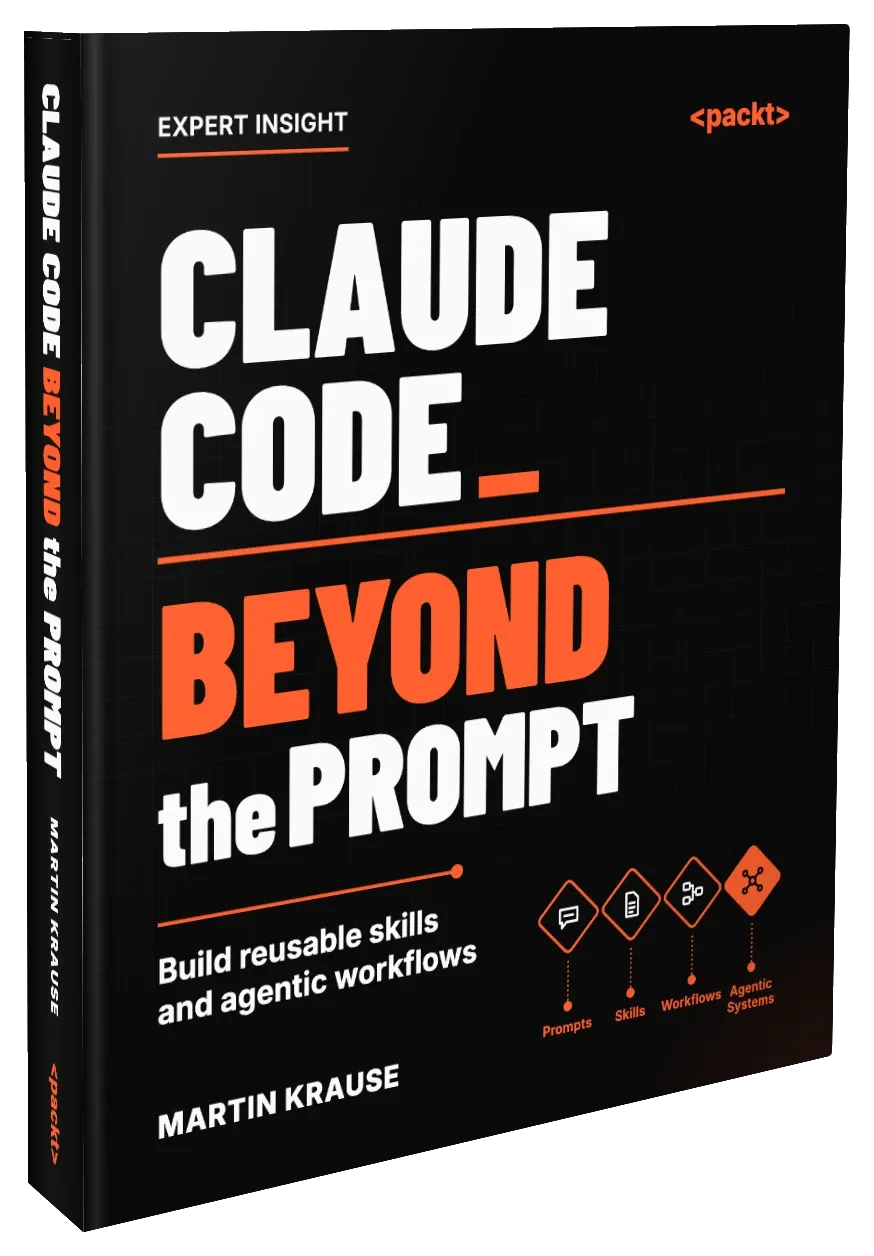
Build reusable skills and agentic workflows. Move from one-off prompts to skills, workflows and supervised agents you can test, share and trust.
By Martin Krause · A practical field guide to agentic engineering with Claude and Claude Code.
Companion code on GitHub, free for every reader.
Prompting collapsed the search-and-assemble loop into a single question. But a prompt is tied to one problem, depends on the context you remember to give it, and doesn’t come out the same way twice. This book follows one path from there to supervised agents, one level at a time.
Powerful for one answer — but fragile, unrepeatable, and rebuilt from memory every time.
The method behind a recurring prompt, packaged in a SKILL.md that Claude recognizes and applies on its own.
Several reliable steps with inputs, checks, decisions and a stopping point — tested, maintained and shared.
Agents that gather, act and verify, connected to real tools through MCP — inside a supervised workbench.
Don’t start by asking “Can I make this an agent?” Ask “What loop does this task need?”
— from Chapter 2
Claude is the lens, but the patterns carry over to other agents too, including Copilot and Codex.
Spot the stable structure under your prompts and turn it into an explicit, repeatable method.
Write, trigger-test and refine skills that activate on the right requests — and stay silent on near-misses.
Capture inputs, steps, checks and decisions in a WORKFLOW.md your whole team can rely on.
Know when a task needs a prompt, a skill, a workflow or an agent — and pick the smallest structure that fits.
Give agents real evidence through MCP while keeping retrieved content as data, not instructions.
Combine CLAUDE.md, permissions, hooks and validators into a supervised setup you control.
This book is hands-on from page one. Each chapter adds a level to the same project, so you finish with working artifacts, not just notes.
You don’t need a machine learning background. If you’ve used Claude or another chat assistant and tried a few prompts, you’re ready.
All examples use ToDo Mate, a small Vite and TypeScript todo app that saves
to localStorage. It comes with real bugs to investigate, from a blank page on
load to tasks that vanish after a refresh.
It runs alongside Kamori, a lightweight, self-hosted log server with a native MCP interface. Early on, you paste Kamori’s logs in as evidence. Later, Claude Code queries them directly.
The repository has one folder per chapter. Each folder holds the app as it stands in that chapter, plus the skills, workflows and Claude Code configuration you build there.
Skills, workflows and CLAUDE.md files are all Markdown. New to Markdown? Start with
our Markdown basics reference.
CLAUDE.md | Code in text — file names, commands, folder names and user input. |
```markdown | Code blocks — skills, workflows and prompts are plain Markdown files. |
trc_51y8un | Timestamps and trace IDs in log listings are examples. Yours will differ, so don’t copy them verbatim. |
Every chapter leaves you with an artifact that the next one builds on. Open a chapter to see what you’ll make.
Why one-off prompting degrades through inconsistency, drift and context loss — and the ladder from prompt to pattern, method, template, skill, workflow and agent.
A precise vocabulary for model, tool, agent, subagent, context and memory — and the agentic loop that connects them.
When a prompt earns promotion to a skill, the three-layer structure of metadata, instructions and resources, and progressive disclosure.
The smallest complete loop: a narrow task, a description that is both trigger and promise, concrete steps, light guardrails and real tests.
Scope with Always / Ask first / Never, move depth into reference files, and tighten triggers so a skill activates only when it should.
Separate the moment from the method and expose inputs, steps, checks, decisions and outputs as a shareable process.
A decision framework where the task defines the structure: the smallest shape that fits, worked through one bug at every level.
Behavioral tests, maintenance notes and review boundaries that make a workflow explain itself once others depend on it.
Gather, act, verify: run a real investigation end to end and fix the ToDo Mate persistence bug at its root.
Choose the environment from the work itself — what the agent must see, do, and when you need to step in.
The agentic harness and its control plane: CLAUDE.md, context coordination, reusable capabilities, extensions and permissions.
Action contracts, output contracts and a deterministic validator — with tighter approval the further a tool can reach.
Connect the investigation to Kamori through MCP, tell retrieval from connection, and treat what comes back as data.
Assemble subagents, MCP, hooks and a human approval gate into one supervised setup — instruction steers, the harness enforces.

Martin Krause is an AI consultant, full-stack solution architect and engineering leader with over 20 years of experience delivering scalable digital platforms and advising global organisations.
Trained at Oxford Saïd Business School and LSE-certified in AI ethics, he applies AI and modern architectures to real-world business challenges. He writes regularly for Germany’s largest IT magazine, is the author of The Complete Developer, and builds AI-driven products that bridge cutting-edge technology with practical impact.
More at mkrause.info
Out November 10, 2026 from Packt. Pre-order now and get the book on release day.